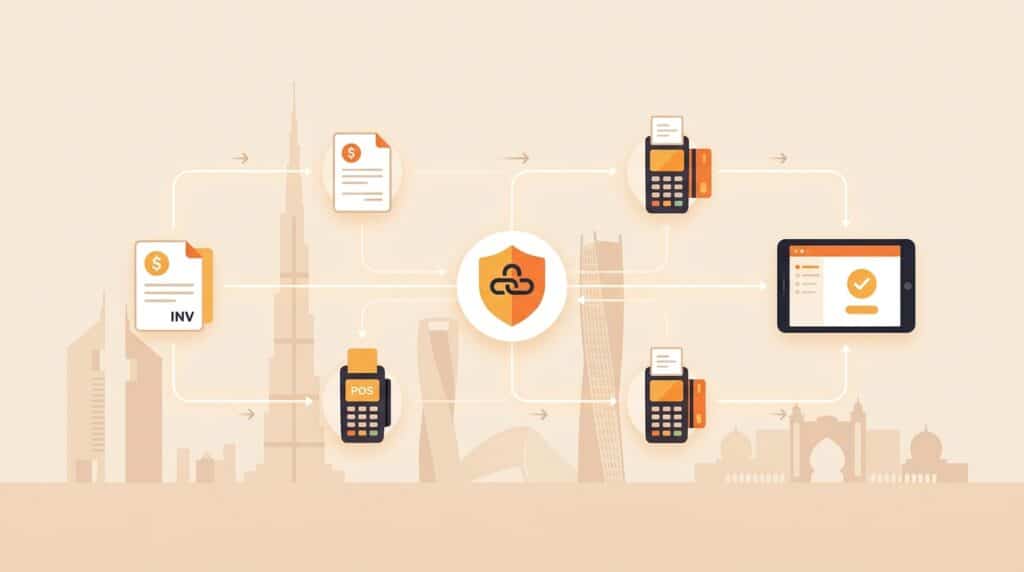
B2B payment gateway integration in the UAE allows businesses to accept digital corporate payments, automate invoicing, and reconcile accounts directly through software systems. UAE companies typically connect an online gateway to their enterprise resource planning (ERP) or accounting software using secure application programming interfaces (APIs). This setup helps finance teams handle commercial transactions in UAE Dirhams (AED) and foreign currencies.
What is B2B payment gateway integration in the UAE?
B2B payment gateway integration is the process of linking a commercial website, portal, or invoicing system to a digital payment processing provider. Unlike retail consumer gateways that focus on one-off shopping basket checkouts, business-to-business gateways manage complex commercial billing.
API: application programming interface, a secure digital connection that allows two different computer systems to share data automatically.
In the UAE, business gateways commonly support direct corporate card payments, virtual account transfers, and automated bank debits. Finance teams use these systems to reduce manual paperwork and see customer payments as they arrive.
How does the B2B payment gateway integration process work?
Connecting a gateway to your commercial accounting workflow involves technical setup, compliance checks, and testing. Most UAE commercial providers follow a structured onboarding path.
- Submit corporate registration documents, including your valid UAE trade licence, memorandum of association, and corporate bank details.
- Select your integration method, such as a pre-built accounting plugin, hosted payment page, or custom API connection.
- Configure security parameters and credentials within a sandbox testing environment.
- Run test transactions for card processing, automated recurring billing, and refund workflows.
- Move to production once testing is complete, then start accepting payments from corporate clients.
Each payment provider reviews merchant accounts individually before issuing production API keys. Requirements and activation times vary by provider.
What technical features should UAE finance teams evaluate?
Business payments involve larger transfer amounts and stricter accounting rules than consumer sales. When assessing integration options, UAE companies should look at how the gateway handles enterprise data.
| Feature | Operational purpose | Why it matters for UAE businesses |
|---|---|---|
| Multi-currency support | Accepts AED, USD, EUR, and other major currencies | Helps manage regional cross-border client invoices without manual conversion steps |
| ERP and accounting sync | Sends transaction data to your ERP or accounting software | Reduces manual bookkeeping entries |
| Tokenisation and PCI compliance | Protects stored corporate card details using random code tokens | Enhances security for recurring supplier or client retainers |
| Batch invoice generation | Generates secure payment links for multiple clients at once | Simplifies collections for wholesale orders and professional services |
How do invoice workflows look in practice?
A well-set-up gateway connection cuts down on manual checks of bank transfers. The table below provides a hypothetical illustration of an automated B2B transaction workflow for an AED commercial invoice.
| Transaction stage | System action | Finance team outcome |
|---|---|---|
| Invoice creation | Accounting software issues an invoice with an embedded payment link | Client receives the invoice directly by email |
| Payment capture | Client pays the invoice using a corporate card or a digital bank transfer | Gateway verifies available funds and records the transaction |
| Reconciliation | Gateway notifies accounting software that the payment succeeded | Invoice marks as paid automatically without manual ledger matching |
| Settlement | Provider transfers the funds to the company’s UAE bank account | Funds become available according to the provider settlement schedule |
Illustration only. Not an offer or a quote from any provider. Actual pricing, settlement times and eligibility are set by the provider. Check current terms with the provider before you decide.
General information only, not financial, legal or tax advice. LeoCompare does not provide payment gateway, merchant acquiring or payment services. Each provider sets its own pricing, settlement times and onboarding requirements, and these can change. Check current terms with the provider before you decide.
Frequently asked questions about B2B payment gateway integration
What documents are required to integrate a B2B payment gateway in the UAE?
UAE providers typically request a valid trade licence, certificate of incorporation, memorandum of association, passport and Emirates ID copies for authorised signatories, and recent corporate bank statements.
Can a UAE B2B gateway handle recurring subscription billing?
Many B2B gateways offer tokenisation features that let you set up automated billing cycles for software licences, retainers, and regular service contracts.
How long does technical integration take for a corporate gateway?
Pre-built plugins usually take less time to set up than custom API integrations, which depend on your developer resources. Timing depends on each provider’s own process and how quickly you can give it the documents it asks for.
Do B2B payment gateways in the UAE support multi-currency settlement?
Many providers support multi-currency processing, allowing companies to invoice in currencies such as USD, EUR, or GBP while settling funds into corresponding foreign currency or AED bank accounts.
Sources and last updated
Sources: Central Bank of the UAE, Retail Payment Services and Card Schemes Regulation (C 15/2021): https://rulebook.centralbank.ae/en/rulebook/retail-payment-services-and-card-schemes-regulation
Last updated: 19 November 2026